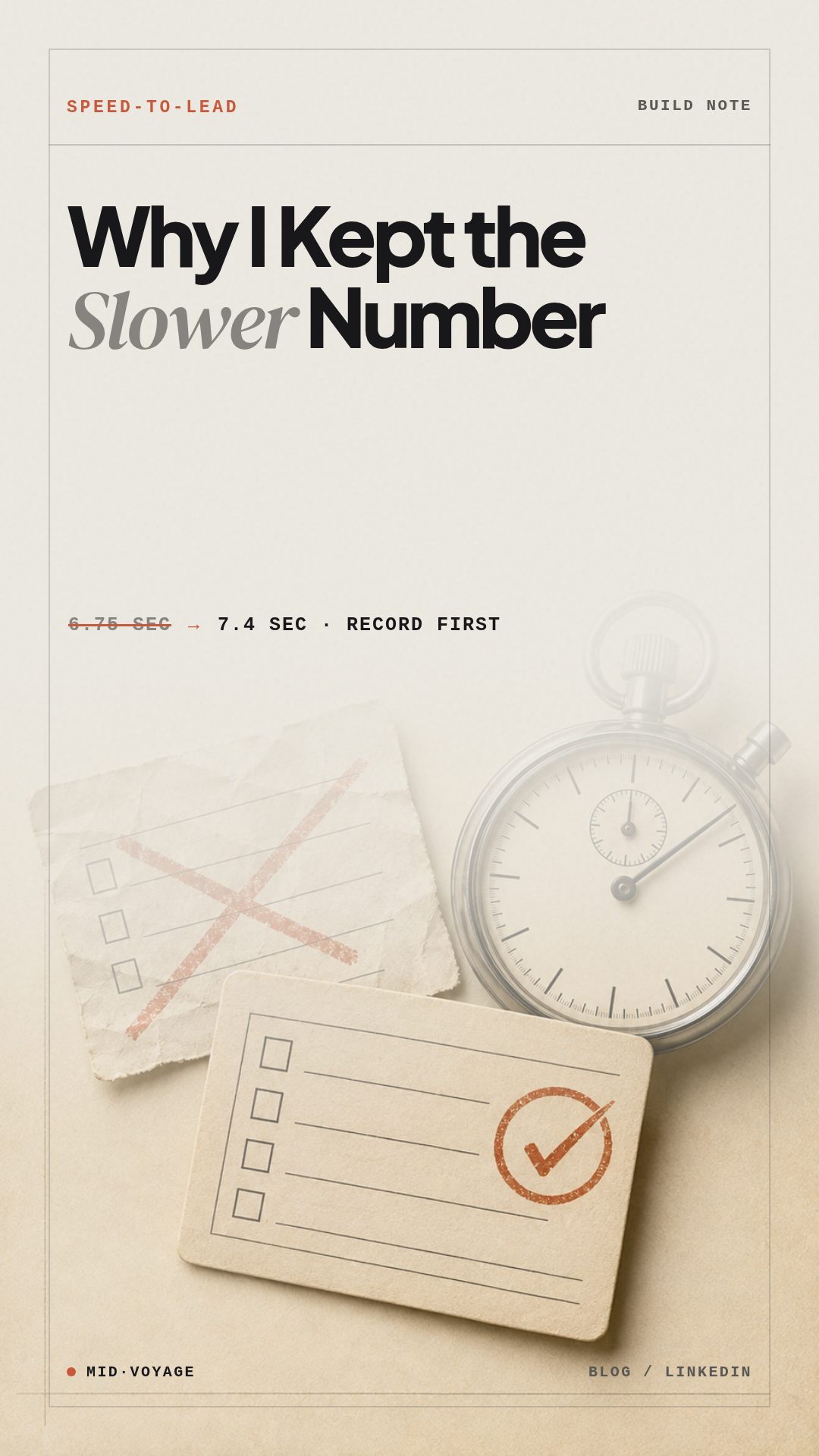
The first version finished in 6.75 seconds.
The safer version took 7.4.
I kept the slower number because the first one measured speed before I fixed the part most likely to lose the lead.
The metric rewarded the wrong finish line
A fast reply looks impressive in a demonstration.
A missing lead does not.
My first workflow treated the email reply, Telegram alert and database record as neighbouring steps. The timer stopped when the workflow finished, so 6.75 seconds looked like the better result.
Then I looked at the order more closely.
The reply and alert were able to leave before the lead had a durable record. If either message succeeded while the database write failed, the customer would think the enquiry was moving while the owner had no dependable record to follow.
The workflow was fast. The hand-off was fragile.
Delay was familiar before I built the workflow
I started in technical support, then moved into real-time operations and training.
On a support floor, delay is visible. Calls stack up. Coverage shifts. One late hand-off changes the next hour.
Later, running a personal training practice meant handling intake, assessment, scheduling, progress records and billing around the visible work. Follow-up was part of the service, even when nobody saw it happening.
Different work, same pattern: an enquiry often arrives before the person responsible has time to process it.
I built Speed-to-Lead to protect the first response without pretending every enquiry deserves the same answer.
The record now comes first
The workflow begins with a form submission.
It checks the submission, scores the lead against written rules and records a reason for the score. One logged run scored a lead 9 out of 10 and stated why.
Hot and nurture leads take different routes. Each receives a reply suited to its route. The owner receives a Telegram alert with the same context.
Pricing and final qualification stay with the owner.
The important change sits earlier in the sequence. Both send paths now depend on the database write.
The lead enters the customer record before the reply or alert leaves the workflow.
If email fails, the record remains. If Telegram fails, the record remains.
The send stopped being the finish line. Durable capture became the finish line.
Four end-to-end runs established the number
The revised workflow ran end to end across four logged executions.
The public figure is 7.4 seconds, taken from the final record-first order.
The earlier 6.75-second result belongs to the old structure. It measured the workflow before the safer dependency was added.
I kept 7.4 because it describes the version I would hand over.
That distinction matters. A benchmark earns trust only when it measures the system someone will receive, not the version with the most flattering timer.
A clean install had to produce a real receipt
The workflow later went through a fresh installation on a clean n8n instance.
The test fired a real test message. It did not pass until the run returned a real Telegram message ID.
This moved the proof beyond a healthy-looking workflow screen. The result showed the message had reached the service responsible for delivering it.
Green nodes are useful. A delivery receipt is better.
Speed still needs a boundary
The workflow handles timing, sorting, recording and notification.
It does not negotiate a price. It does not make the final sales decision. It does not pretend a score replaces judgement.
Its job is narrower: receive the enquiry, preserve the record, send the appropriate first response and place the context in front of the owner.
The fastest number would have made the cleaner headline.
The slower number tells the truth about the system.
Useful speed still leaves a trail.
Built by handlit.